


Join One Charlotte Realty: The 100% Commission Real Estate Brokerage Serving Charlotte, Fort Mill, Rock Hill & Beyond
July 3, 2026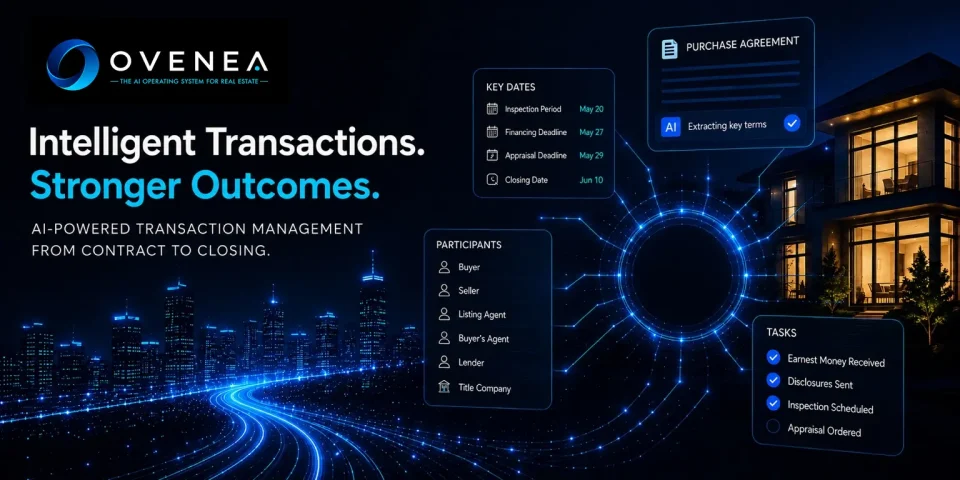
How AI Is Changing Real Estate Transactions: Introducing Ovenea
Artificial intelligence is transforming real estate. One of its biggest opportunities may not be property search or marketing—but the transaction itself.
Artificial intelligence is rapidly changing the real estate industry.
Much of the attention has focused on AI-powered property searches, automated valuations, virtual staging, lead generation, real estate marketing, and AI chatbots. But one of the largest opportunities for artificial intelligence in real estate exists after a buyer and seller agree to a deal.
The transaction itself.
Residential real estate transactions remain remarkably fragmented. Contracts, addenda, disclosures, inspections, financing, title work, closing documents, deadlines, emails, compliance requirements, and communication between multiple parties can be spread across different systems.
That fragmentation creates administrative work, duplicated effort, missed information, and unnecessary risk.
Ovenea is being built to change that.
Ovenea AI Real Estate Transaction Management Platform is an emerging AI-powered real estate technology platform designed around a broader vision for how real estate transactions can be managed.
The AI Operating System for Real Estate.
Why Real Estate Transaction Management Needs to Evolve
A real estate transaction may appear straightforward to a consumer: make an offer, obtain financing, complete inspections, and close.
Behind the scenes, considerably more is happening.
- Purchase agreements and contract addenda
- Disclosures and supporting documents
- Inspection periods
- Earnest money and deposit deadlines
- Financing and loan milestones
- Appraisal requirements
- Title and closing coordination
- Repair negotiations
- Contract amendments
- Association and condominium requirements
- Compliance documentation
- Communication between transaction participants
- Closing deadlines
- Brokerage records and audit requirements
The problem is not necessarily that the industry lacks software.
The problem is that much of today’s real estate software still requires people to interpret information and manually move it between disconnected systems.
A contract may be stored in one platform. Tasks may exist somewhere else. Emails are in another application. Compliance is handled through another process. Transaction coordinators maintain their own checklists. Brokers have separate oversight responsibilities.
The result is often a collection of software tools rather than a truly intelligent transaction environment.
What Is AI Real Estate Transaction Management?
Traditional transaction management software primarily helps real estate agents and brokerages organize information.
Artificial intelligence creates the possibility of software that can increasingly understand information.
That distinction is significant.
Real estate contracts contain dates, obligations, contingencies, financial terms, parties, amendments, and other information that affects what must happen throughout a transaction.
Modern AI technologies create opportunities for real estate software to assist professionals with understanding and managing that information more efficiently.
The next generation of real estate transaction management software should therefore move beyond digital checklists and document storage.
It should become more intelligent, more proactive, and more deeply connected to the transaction itself.
That is the category Ovenea is being built to address.
From Real Estate Software to Real Estate Intelligence
Real estate technology has traditionally been divided into specialized categories.
There are CRM platforms, electronic signature systems, transaction management platforms, document storage systems, marketing platforms, accounting systems, compliance systems, lead-generation platforms, and numerous other PropTech products.
Each solves a specific problem.
But the transaction is where many of those activities ultimately converge.
What happens when intelligence is built around the transaction itself?
Ovenea is being developed around that broader concept.
The objective is not simply to add an AI chatbot to traditional transaction management software. It is to rethink how real estate transactions can be managed when artificial intelligence becomes part of the underlying operating environment.
AI and Real Estate Contract Intelligence
Contracts are among the most information-dense components of a real estate transaction.
A purchase agreement can establish critical dates, financial obligations, contingencies, responsibilities, and conditions affecting numerous participants.
Yet much of that information still has to be manually reviewed and translated into action.
This is one reason AI contract intelligence for real estate could become increasingly important.
Artificial intelligence has the potential to help professionals identify relevant information contained within transaction documents and make that information easier to manage throughout the life of a transaction.
The objective should not be to replace professional judgment. It should be to reduce unnecessary administrative work while helping professionals maintain better visibility into the transaction.
Better Real Estate Deadline Management
Deadlines are fundamental to real estate transactions.
Inspection periods, deposits, financing milestones, appraisal requirements, association applications, title matters, and closing dates can all have contractual consequences.
Traditional transaction management often requires someone to manually identify those dates and enter them into a calendar or checklist.
AI-powered real estate technology creates the possibility of a more intelligent approach to real estate deadline management.
The long-term opportunity is a transaction environment in which important information does not simply sit inside documents waiting for someone to find it.
Instead, technology can help professionals surface relevant information when it matters.
AI for Real Estate Compliance and Brokerage Oversight
The opportunity extends beyond individual agents.
Real estate brokers must oversee transactions across multiple agents while maintaining documentation and compliance standards.
As a brokerage grows, oversight becomes increasingly difficult.
Traditional compliance processes often depend on manual document review, checklists, email communication, and administrative staff.
AI-powered systems may eventually help brokerages create a more consistent and scalable approach to real estate compliance management and brokerage transaction oversight.
The key is not simply automation.
It is visibility.
A broker should be able to understand what is happening across the brokerage without manually reconstructing every transaction from documents, emails, and disconnected software systems.
The Future of the Real Estate Transaction Coordinator
Transaction coordinators perform valuable work because residential transactions contain enormous amounts of administrative complexity.
AI will change that role.
It does not necessarily mean that human transaction coordinators disappear. It means the division of labor between humans and software is likely to change substantially.
Routine administrative work can increasingly be assisted by technology, allowing professionals to concentrate on exceptions, negotiations, communication, judgment, and problems requiring human involvement.
The future may therefore be less about replacing the transaction coordinator and more about creating an AI real estate transaction coordinator that works alongside agents, brokers, and transaction professionals.
Real Estate Agents Should Spend Less Time on Administration
Real estate agents are paid for activities such as prospecting, negotiating, advising clients, winning listings, showing property, solving problems, and closing transactions.
They are not paid more because they spent another hour copying dates between systems.
Yet administrative work consumes a substantial portion of many agents’ working days.
The next generation of AI tools for real estate agents should attack that inefficiency.
Technology should reduce the amount of repetitive transaction administration required from the agent while improving access to important information.
An agent should remain responsible for professional judgment and client representation. Software should become better at handling the administrative burden surrounding that work.
Why Charlotte Real Estate Professionals Should Pay Attention
Charlotte is a major residential real estate market with agents, brokerages, buyers, sellers, lenders, attorneys, inspectors, and other professionals participating in transactions throughout the region.
As transaction technology evolves, competitive advantage will increasingly come from operational efficiency as well as sales ability.
Brokerages capable of handling more transactions without proportionally increasing administrative overhead will have an advantage.
Agents capable of spending more time with clients and less time managing paperwork will have an advantage.
The transition from traditional real estate software toward AI-powered real estate transaction management will affect Charlotte real estate professionals just as it will affect the broader national market.
What Is Ovenea?
Ovenea is an AI-powered real estate technology company currently under development.
Its long-term vision is expressed in its positioning:
OVENEA
The AI Operating System for Real Estate
The platform is being designed around the real estate transaction and the information, documents, participants, responsibilities, and workflows surrounding it.
Specific proprietary functionality, technical architecture, AI methodologies, workflows, and future capabilities are intentionally not being publicly disclosed before launch.
What can be disclosed is the larger objective.
Ovenea is being built to explore what becomes possible when artificial intelligence is integrated more deeply into real estate transaction management, contract intelligence, compliance, workflow automation, and brokerage operations.
That is a substantially larger idea than simply adding AI features to existing real estate software.
AI Will Not Eliminate the Complexity of Real Estate
Real estate transactions are not merely data-processing exercises.
They involve negotiations, legal documents, changing circumstances, financing issues, inspection problems, emotional decisions, regulatory requirements, and human judgment.
AI does not eliminate those complexities.
Good real estate technology should make complexity easier to manage.
The strongest platforms are unlikely to be those promising that AI can magically replace every professional involved in a transaction.
They will be platforms capable of intelligently connecting humans, documents, information, and workflows while maintaining appropriate human oversight.
The Bigger Opportunity: The Transaction as the Center of Real Estate Technology
For years, much of real estate technology has been organized around the agent.
CRMs manage the agent’s contacts.
Marketing platforms promote the agent.
Lead-generation platforms deliver prospects to the agent.
Transaction management platforms help the agent manage files.
But the underlying economic event is the transaction.
Buyers, sellers, agents, brokers, lenders, attorneys, title professionals, inspectors, appraisers, insurance providers, associations, and other participants can all intersect around a single residential transaction.
That suggests a different way of thinking about the future of PropTech.
Instead of building another isolated application, technology can potentially organize itself around the transaction.
Ovenea’s long-term vision begins with that premise.
The Future of AI in Real Estate Is Just Beginning
Artificial intelligence will affect virtually every major part of residential real estate.
The important question is no longer whether AI will change real estate.
It is where AI will create the greatest structural advantage.
Ovenea is being built on the belief that one of those opportunities sits at the center of the industry:
The real estate transaction itself.
ABOUT OVENEA
Ovenea — The AI Operating System for Real Estate
Ovenea is an emerging real estate technology platform focused on bringing artificial intelligence, transaction intelligence, workflow automation, and modern software infrastructure to the residential real estate transaction.
The platform is currently under development. Certain functionality and technical details remain confidential prior to launch.
ABOUT ONE CHARLOTTE REALTY
Charlotte Real Estate
One Charlotte Realty serves buyers and sellers throughout the Charlotte real estate market and surrounding communities in North Carolina and South Carolina.
Oliver Hoffmann Digital Business Card
Ovenea on Instagram
Ovenea – The AI Operating System for Real Estate
Ovenea on LinkedIn